Turning Data
Into Profits
Published: 25 March 2015 | Updated: 15 December 2025
Smart FAI is an intelligent, AI-powered First Article Inspection (FAI) software for manufacturing companies in Malaysia, designed to digitalise, streamline, and automate the entire FAI process. The system automatically balloons PDF and engineering drawings, captures dimensions with AI-driven recognition, and accurately interprets GD&T symbols and general tolerances. It centralises visual and measurement data collection, replacing manual Excel- or paper-based inspection with a fast, standardised digital workflow that reduces human error and inspection time.
With built-in tools to generate fully customised and AS9102-compliant First Article Inspection reports, Smart FAI gives quality and engineering teams real-time insight into part conformity, customer requirements, and process capability. Manufacturers can improve overall quality assurance, increase inspection throughput, and strengthen regulatory and customer compliance across aerospace, automotive, precision machining, electronics, and other high-mix, high-precision industries.
In high-precision industries such as aerospace, automotive, precision machining, electronics and medical devices, very small dimensional errors can lead to serious quality issues, safety risks and costly recalls. First Article Inspection provides a structured way to confirm that tooling, programs and processes are set up correctly before full-scale production.
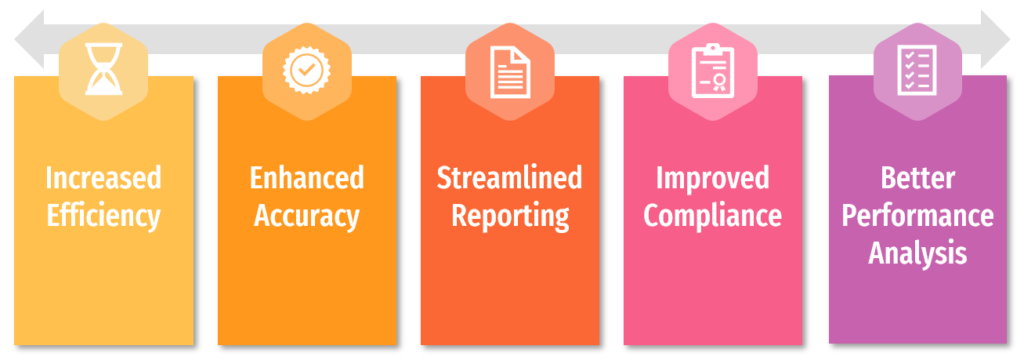
A robust FAI process helps manufacturers:
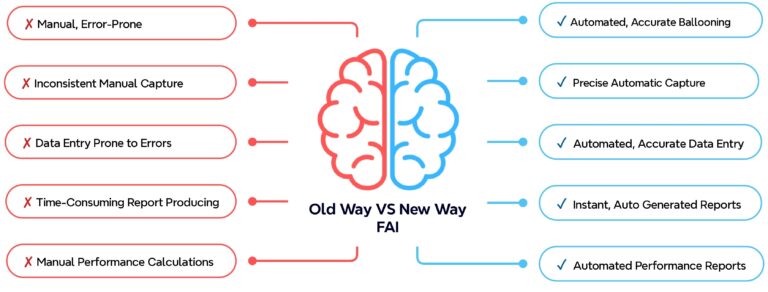
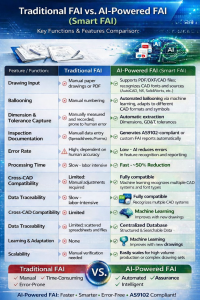
Conventional First Article Inspection workflows using Excel are also very labour-intensive. Dimensions and tolerances must be typed into Excel or other spreadsheets, one by one, from the printed drawing to the inspection sheet. This manual data entry is time-consuming and prone to typing errors, especially when there are hundreds of characteristics. As a result, the manual FAI process slows down new product introduction (NPI), increases inspection lead time and raises the risk of wrong values being used on the shop floor.
Because traditional FAI is driven by paper forms and spreadsheets, FAI report generation often becomes a serious bottleneck. Inspectors must copy data from measurement sheets into templates, re-check calculations and reformat tables for each customer. This repetitive work not only delays delivery of First Article Inspection reports, but also increases the chance of human errors, missing entries, inconsistent formats and rejected submissions from the customer’s quality team.
At the same time, many aerospace, automotive and precision manufacturing customers now require AS9102-compliant FAI reports or strict customer-specific formats. With a manual FAI process based on paper and Excel, keeping up with different templates, drawing revisions and documentation rules is very challenging. Teams spend valuable time adjusting spreadsheets, re-typing information and fixing formatting issues just to satisfy each customer. This makes it harder to demonstrate full compliance with AS9102, OEM quality requirements and audit expectations, and increases the risk of delays, rework and non-compliance findings during customer or regulatory audits.
Manufacturers face significant challenges in the FAI process:
Auto PDF Drawing Ballooning
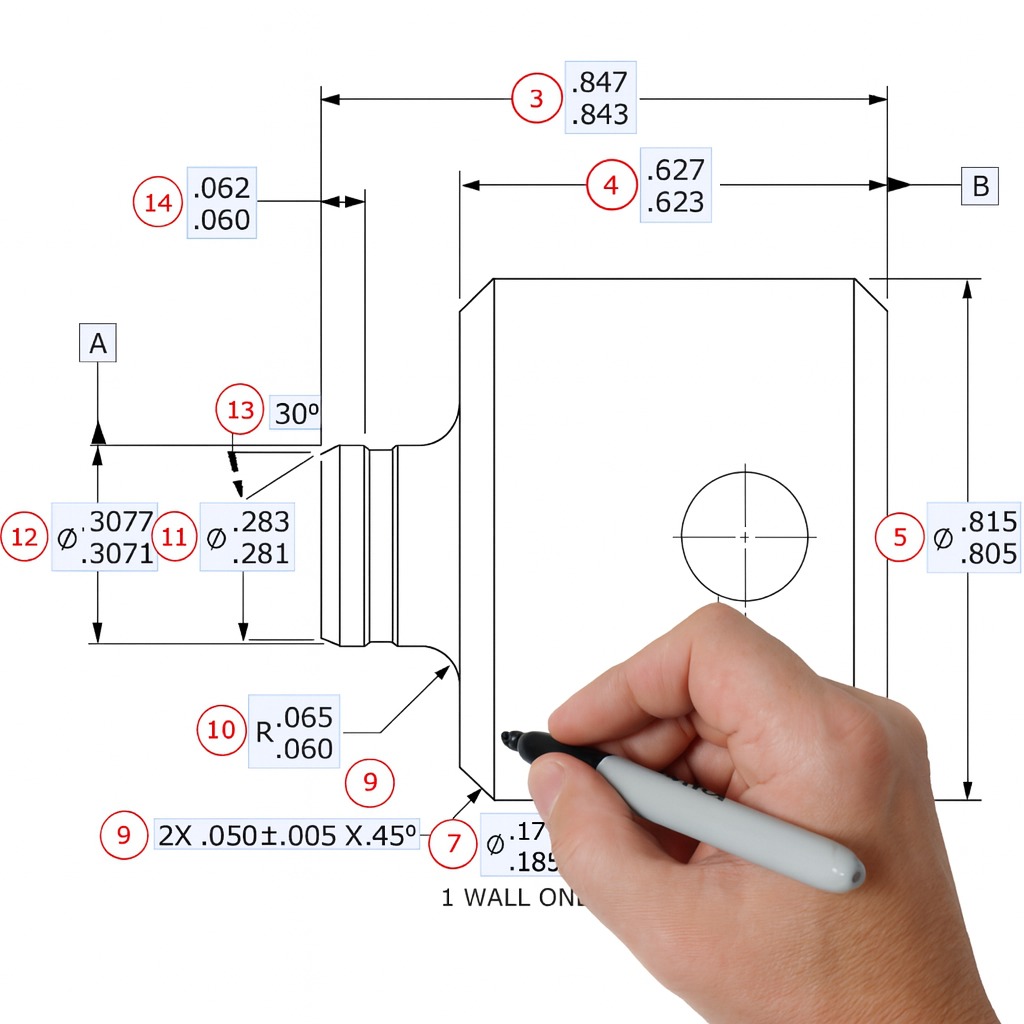
AI-powered First Article Inspection software automatically balloons engineering drawings in PDF format, eliminating slow manual numbering and highlighting. The system scans the drawing, detects dimensions, notes and geometric features, then generates clear balloon numbers linked to each characteristic. This reduces preparation time, improves consistency between inspectors and ensures every critical dimension is captured for the First Article Inspection (FAI) report.
AI Dimension & GD&T Recognition
Using computer vision and AI, the software reads dimensions, tolerances and GD&T symbols directly from the drawing instead of relying on manual typing into Excel. Linear, radial and angular dimensions, as well as feature control frames, are extracted and mapped to the corresponding balloons. This automation minimises human error, speeds up data entry and ensures that all design requirements are correctly transferred into the inspection plan and FAI report.
Measurement & Visual Data Collection
During inspection, the FAI software provides a digital checklist based on the ballooned characteristics, allowing inspectors to capture measurement values and visual findings in one place. Measurement data can be keyed in or imported from gauges and measuring devices, while photos and visual evidence can be attached to each characteristic. This centralised data collection replaces scattered paper forms, improves traceability and makes it easy to review measurement trends and nonconformities.
AS9102 and Customer-Format Report Generation
Once inspection is complete, the system automatically compiles all recorded data into structured First Article Inspection reports, including AS9102-compliant forms and customised customer-specific templates. Balloon numbers, drawing characteristics, specification limits, measured values and pass/fail status are aligned and formatted with a single click. This saves significant reporting time, standardises documentation across projects and helps manufacturers demonstrate compliance quickly to aerospace, automotive, precision machining, electronics and other high-precision customers.
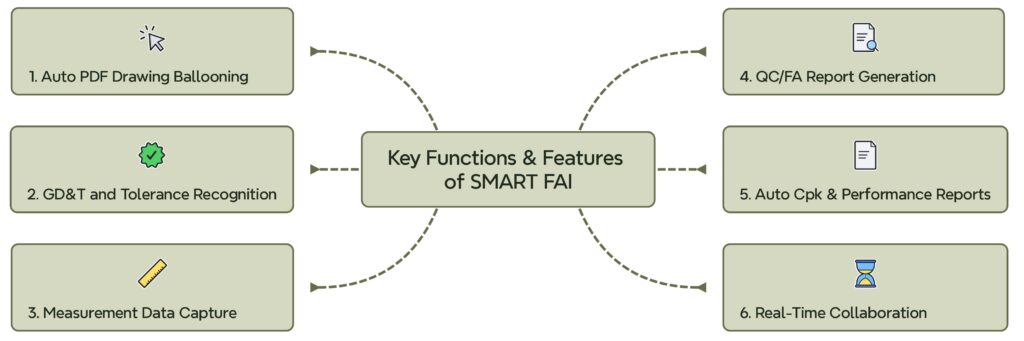
Smart FAI revolutionizes the First Article Inspection (FAI) process by automating ballooning of technical drawings, dimension measurement, and inspection data collection. It delivers high-precision GD&T and tolerance recognition, while automatically generating detailed quality control (QC) reports, FAI documentation, and Cpk performance analysis. This advanced FAI software solution improves inspection accuracy, boosts operational efficiency, and ensures full compliance with industry standards like AS9102, making it ideal for manufacturers focused on quality assurance and regulatory compliance.
1. What is First Article Inspection (FAI)?
First Article Inspection (FAI) is a manufacturing quality control and quality assurance process to verify that a new or modified part meets all engineering drawing, GD&T and specification requirements before mass production. The first piece is fully measured and documented in a First Article Inspection report, proving the process is capable, stable and compliant with customer and industry standards.
2. Why use First Article Inspection software instead of Excel?
Paper and Excel-based First Article Inspection are slow, manual and error-prone. Engineers must balloon drawings, type every dimension and build reports by hand. FAI software automates PDF drawing ballooning, AI dimension and GD&T recognition, and FAI report generation, reducing human error, shortening FAI cycle time and simplifying compliance with AS9102 and customer-specific requirements.
3. Which industries need AI First Article Inspection software?
AI First Article Inspection (FAI) software is ideal for aerospace, automotive, precision machining, electronics and medical devices. These industries deal with tight tolerances and strict customer specifications, so digital FAI helps reduce scrap and rework, improve traceability and audit readiness, and build stronger customer confidence in critical components.
4. How does AI-powered First Article Inspection software work?
AI-powered FAI software automatically balloons PDF engineering drawings, detects dimensions, tolerances and GD&T symbols using computer vision, and creates a digital inspection checklist. Inspectors record measurement values and visual findings directly in the system, which then generates structured First Article Inspection reports, including AS9102-compliant and customer-specific formats, with just a few clicks.
5. Can the system generate AS9102-compliant FAI reports?
Yes. Modern First Article Inspection software can generate AS9102-compliant FAI reports and customised customer templates. Balloon numbers, drawing characteristics, specification limits, measured values and pass/fail status are automatically aligned, helping aerospace and other regulated manufacturers deliver consistent FAI documentation and demonstrate compliance with AS9102 and OEM quality requirements.
6. How does Smart FAI integrate with other quality and production systems?
Smart FAI integrates with QC/SPC software, Quality Management Systems (QMS), Manufacturing Execution Systems (MES) and, where needed, ERP or PLM. This connects FAI results, quality data and production information, supporting full traceability from design and first article approval through to mass production and ongoing process monitoring in an Industry 4.0 smart factory.
Contact Us Today to Start Your Digital Transformation Journey!
Blue Ocean Data Solutions is a highly experienced company provides turnkey manufacturing solutions. With more than 10 years of experience serving a large customer base in manufacturing and hands-on expertise in programming, software and statistical data analysis combine with six sigma and lean manufacturing methodology, we assist our clients to solve complicated operation problems – yielding profitability increases and driving service and product delivery excellence.
Company
Contact Us